Yipy Box - Smart Locker
Yipy Box - Smart Locker
LIVE
LIVE
LIVE
LIVE
LIVE
LIVE
LIVE
LIVE
LIVE
LIVE
Upgrading parcel management for
Upgrading parcel management for
modern living.
modern living.
Yipy Box solves this with a shared, real-time status for every
package, from the moment it arrives at the building to the moment
it's picked up. Security teams log it once, residents see exactly
where it is, and nobody has to ask "paket saya di mana?" again.
Yipy Box solves this with a shared, real-time status for every package, from the moment it arrives at the building to the moment it's picked up. Security teams log it once, residents see exactly where it is, and nobody has to ask "paket saya di mana?" again.
UI/UX Design
UI/UX Design
Mobile App
Mobile App
Admin Dashboard
Admin Dashboard
Industry
Industry
Building Management
Building Management
Role
Role
UI UX Designer
UI UX Designer
Platform
Platform
Admin Dashboard, Tablet & Mobile App
Admin Dashboard, Tablet & Mobile App
Overview
Overview
🤔 : “At first glance, receiving a package feels simple”
🤔 : “At first glance, receiving a package feels simple”
Situation
Situation
In reality, it rarely is. Packages arrive when residents aren’t home. Security officers juggle handwritten logs. And even after getting a delivery notification, residents still ask the same question:
“Paket saya disimpen di mana ya?”
The problem isn’t delivery. It’s the lack of visibility after it arrives.
Problem
Problem
Parcel handling in apartments is still manual, fragmented, and reactive.
Security teams rely on paper logs or chat messages
Residents have no visibility into package status
Packages pile up, get misplaced, or picked up late
The issue isn’t the lack of effort. It’s the lack of a clear system.
Parcel handling in apartments is still manual, fragmented, and reactive.
Security teams rely on paper logs or chat messages
Residents have no visibility into package status
Packages pile up, get misplaced, or picked up late
The issue isn’t the lack of effort. It’s the lack of a clear system.
Goals
Goals
Design a parcel management solution that works across daily operations.
Design a parcel management solution that works across daily operations.
1
1
Building Managements
Building Managements
Building Managements
Turn messy lobby storage into a controlled, trackable system
Reduce operational risk from lost or unclaimed packages
Get visibility into parcel activity without manual reports
Turn messy lobby storage into a controlled, trackable system
Reduce operational risk from lost or unclaimed packages
Get visibility into parcel activity without manual reports
2
2
Security Teams
Security Teams
Security Teams
Log incoming packages in seconds
Store parcels in an organized, secure locker
Track pickup status without paper logs or follow-ups
Log incoming packages in seconds
Store parcels in an organized, secure locker
Track pickup status without paper logs or follow-ups
3
3
Residents
Residents
Residents
Know exactly where their package is stored
Get clear pickup instructions through the app
Collect parcels without waiting or confusion
Know exactly where their package is stored
Get clear pickup instructions through the app
Collect parcels without waiting or confusion
Research
Research
As a UI/UX Designer, after observing daily operations and listening to residents’ feedback, a few important insights became clear:
As a UI/UX Designer, after observing daily operations and listening to residents’ feedback, a few important insights became clear:

People don’t mind waiting. What frustrates them is not knowing where their package is, who’s holding it, or what they’re supposed to do next.
The lack of clarity turns a simple pickup into repeated questions and unnecessary tension.
People don’t mind waiting. What frustrates them is not knowing where their package is, who’s holding it, or what they’re supposed to do next.
The lack of clarity turns a simple pickup into repeated questions and unnecessary tension.
As packages pile up, handwritten logs and lobby storage quickly break down. What starts as a temporary workaround becomes a daily source of confusion for security teams, building management, and residents alike. Without a clear system, responsibility becomes blurred.
As packages pile up, handwritten logs and lobby storage quickly break down. What starts as a temporary workaround becomes a daily source of confusion for security teams, building management, and residents alike. Without a clear system, responsibility becomes blurred.
"
These insights shaped every decision that followed not to add more rules, but to introduce structure, visibility, and ownership.
These insights shaped every decision that followed not to add more rules, but to introduce structure, visibility, and ownership.
Our approach to
clarity and
ownership
Our approach to clarity and ownership
Instead of adding more rules, paperwork, or additional manual checkpoints, we chose to step back and look at where the real friction was happening.
The problem wasn’t a lack of effort from security teams or building management it was the absence of a system that clearly defined responsibility and status at every stage.
So we focused on two fundamentals, visibility and ownership. Visibility ensures everyone can see what’s happening. Ownership ensures everyone knows who is responsible, and when that responsibility ends.
To guide our decisions, we asked a simple but critical question:
What if every package had a clear, shared status from the moment it arrives at the building, to the moment it’s picked up by its owner?
What if every package had a clear, shared status from the moment it arrives at the building, to the moment it’s picked up by its owner?
If that status were visible to security teams, building management, and residents at the same time, most of the daily confusion would disappear without adding more work for anyone.
If that status were visible to security teams, building management, and residents at the same time, most of the daily confusion would disappear without adding more work for anyone.
Flow exploration
Flow exploration
Before finalizing the parcel flow, we explored two different approaches for how incoming packages should be handled by on-site staff.
Before finalizing the parcel flow, we explored two different approaches for how incoming packages should be handled by on-site staff.
Concept 1 : Resident-initiated requests
Concept 1 : Resident-initiated requests

In this approach, residents are required to submit a request in the Yipy app before a package arrives, indicating that an incoming delivery should be stored inside a Yipy Box.
When a package arrives:
Staff check whether a resident has submitted a request
If a request exists, the package is logged and placed inside Yipy Box
If no request is found, the package is stored at the reception area
Pros
Pros
Gives residents full control over which packages go into Yipy Box
Prevents locker usage for unexpected or one-off deliveries
Clear intent from the resident before storage
Gives residents full control over which packages go into Yipy Box
Prevents locker usage for unexpected or one-off deliveries
Clear intent from the resident before storage
Cons
Cons
Gives residents full control over which packages go into Yipy Box
Prevents locker usage for unexpected or one-off deliveries
Clear intent from the resident before storage
Gives residents full control over which packages go into Yipy Box
Prevents locker usage for unexpected or one-off deliveries
Clear intent from the resident before storage
Concept 2 : Automatic storage for Yipy users
Concept 2 : Automatic storage for Yipy users

In this approach, every package delivered for a registered Yipy resident is automatically stored inside Yipy Box, without requiring any prior request.
When a package arrives:
Staff verify that the recipient is an active Yipy user
The package is logged and placed directly into Yipy Box
The resident is notified and can collect the package at their convenience
Pros
Pros
Removes unnecessary steps for residents
Faster and more consistent for security teams
Significantly reduces package buildup at the lobby
Aligns with real delivery behavior, not ideal assumptions
Removes unnecessary steps for residents
Faster and more consistent for security teams
Significantly reduces package buildup at the lobby
Aligns with real delivery behavior, not ideal assumptions
Cons
Cons
Requires sufficient locker availability
Less granular control for residents who may not want locker storage
Requires sufficient locker availability
Less granular control for residents who may not want locker storage
From exploration to
a clear decision
From exploration to
a clear decision

While the first concept appeared more controlled on paper, it depended too much on ideal user behavior. In reality, deliveries are often spontaneous, unplanned, and time sensitive.
Concept 2 prioritized operational reliability over conditional logic. By making Yipy Box the default for registered residents, we removed decision making from the moment of delivery and replaced it with a predictable system.
This approach:
Scales better with daily parcel volume
Scales better with daily parcel volume
Reduces ambiguity for staff
Reduces ambiguity for staff
Delivers immediate clarity to residents
Delivers immediate clarity to residents
Design Process
Design Process
The final solution comes to life through a set of interfaces built on Yipy design system: clean, minimal, and intentionally easy to use.
Instead of designing isolated screens, we treated Yipy Box as a cross-platform experience, where each interface plays a specific role while remaining visually and functionally consistent.
Yipy Staff App
Yipy Staff App
This app supports security teams in their daily operations, allowing them to log incoming packages quickly and accurately. The interface prioritizes clarity, large tap areas, and minimal input fields ensuring package data can be recorded efficiently, even during peak delivery hours.
This app supports security teams in their daily operations, allowing them to log incoming packages quickly and accurately. The interface prioritizes clarity, large tap areas, and minimal input fields ensuring package data can be recorded efficiently, even during peak delivery hours.

Yipy Resident App
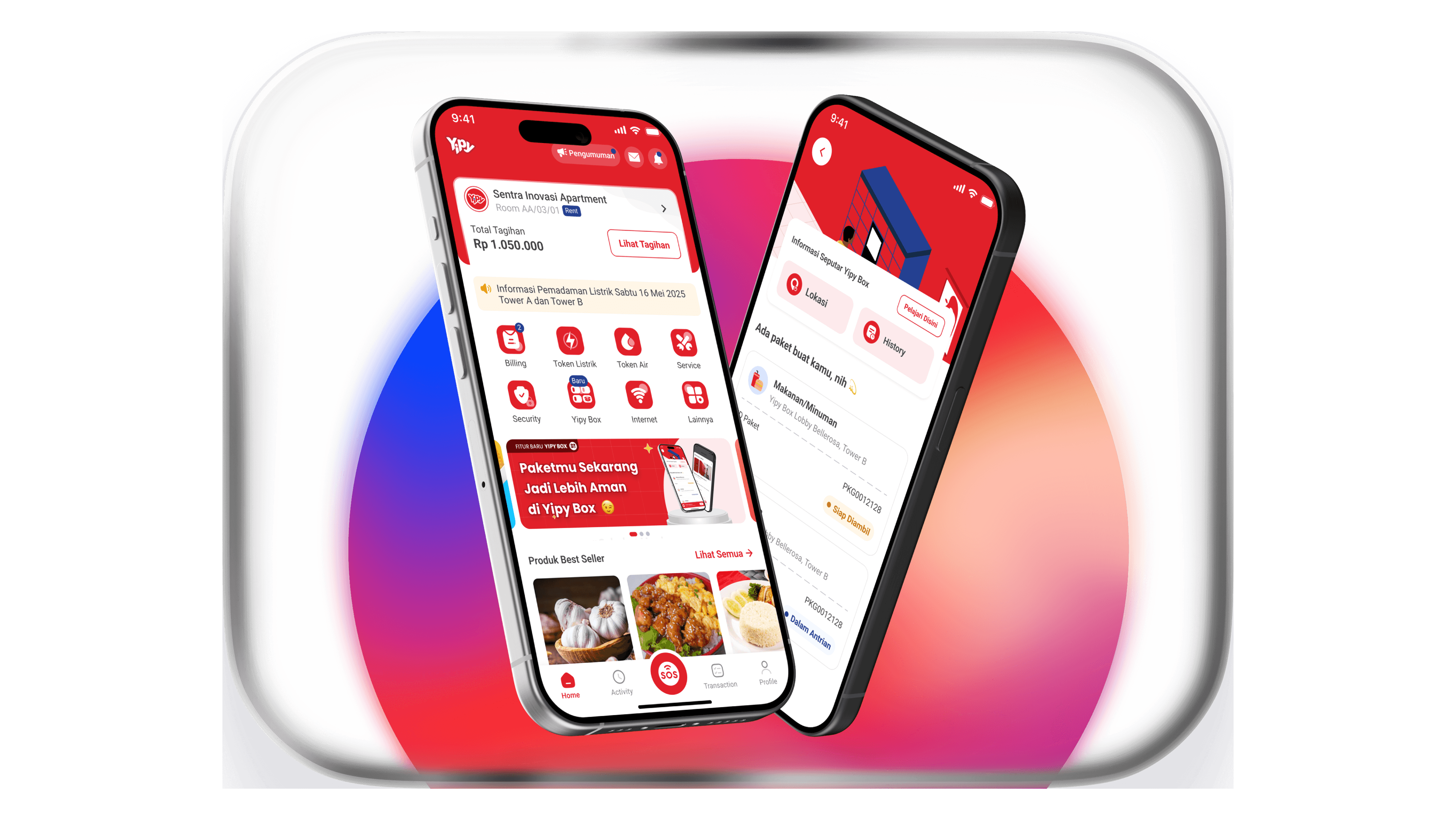
Residents use this app to receive real-time information about their packages, including storage status and pickup instructions. The interface focuses on clear messaging, straightforward actions, and seamless access to the pickup PIN, so residents know exactly what to do, without asking anyone.
Residents use this app to receive real-time information about their packages, including storage status and pickup instructions. The interface focuses on clear messaging, straightforward actions, and seamless access to the pickup PIN, so residents know exactly what to do, without asking anyone.

Yipy Box Tablet / Controller
Yipy Box Tablet /
Controller
The tablet interface on the Yipy Box acts as the physical touchpoint between the system and its users. With a simple, distraction-free layout, it allows staff and residents to enter a PIN to store or retrieve packages securely, ensuring access is controlled, clear, and intuitive.
The tablet interface on the Yipy Box acts as the physical touchpoint between the system and its users. With a simple, distraction-free layout, it allows staff and residents to enter a PIN to store or retrieve packages securely, ensuring access is controlled, clear, and intuitive.

Result 👀
After development and testing were completed, Yipy Box was officially launched and first implemented at MT Haryono Residence.
Beyond the product itself, I took on the responsibility of leading training sessions for on-site teams, guiding them through how Yipy Box works and how it fits into their daily routines.
This hands-on involvement helped ensure the system was not only implemented, but understood and adopted.
Being part of this rollout reinforced why I enjoy working in this space continuously contributing to a team that builds practical solutions for real problems in residential living.
